Fees, pricing, listings and returns for profitable growth on Flipkart. The system PrimeScale uses for Flipkart fees, the ₹999 line, listings, shipping weight, ads and returns, with every fee rule checked against Flipkart’s official fees page.
Know your real profit per delivered order, returns included, before you spend a rupee on ads.
A full worked example on a ₹1,049 product
Why ₹999 can earn ₹65 more per order
How returns spread across delivered orders
Break-even price and break-even ad spend
Part 2
Set up
Build clean data, a catalogue and listings that sell.
03Set up your account and catalogue
Get the foundations right once: the data every listing needs, a clean catalogue and the right way to fulfil.
What to prepare before you list
How to structure SKUs and variants
FBF or NFBF: how to choose
Why your seller tier matters from day one
04Listings that convert
Titles, images and specifications that answer a shopper’s questions before they scroll away.
A title pattern that reads well on a phone
The six-image plan for every SKU
Specifications that prevent returns
A checklist before you publish
Part 3
Grow
Price, ship and advertise without leaking margin.
05Pricing and shipping weight
Set prices that hold margin, and cut shipping fees by shrinking the box.
Four PrimeScale pricing rules
A worked example on a fashion kurta
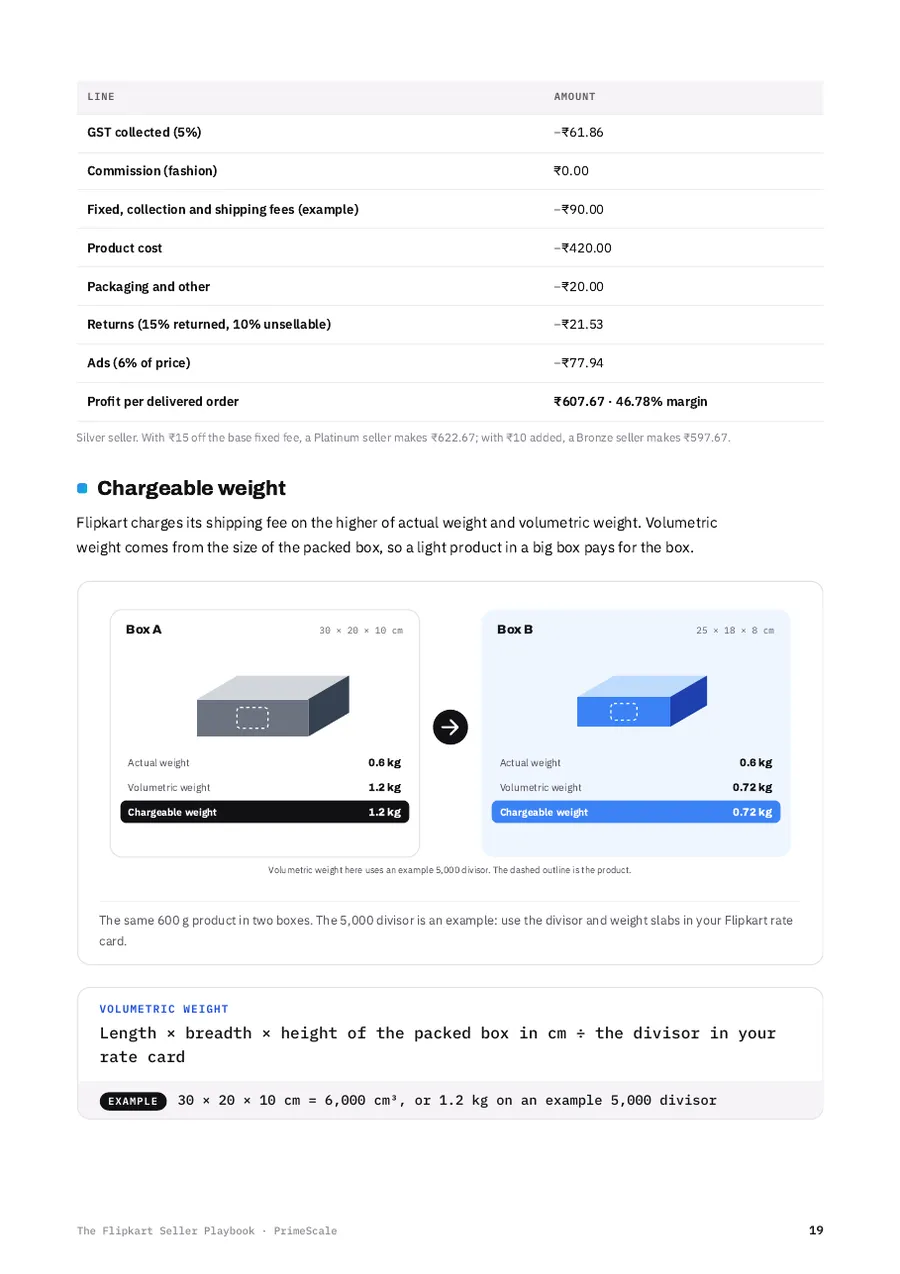
How chargeable weight is worked out
Ways to make the box smaller
06Flipkart Ads without the waste
Run ads to a ceiling your own numbers set, and review them every week.
An ad ceiling for every SKU
A three-stage test plan
The weekly ads review
When to stop spending
Part 4
Scale
Cut returns and run a 90-day plan.
07Cut returns and protect your margin
Returns quietly take profit from every delivered order. Find the cause and fix the listing behind it.
What a return really costs
Five return causes you can control
A weekly returns review
Packing that survives the courier
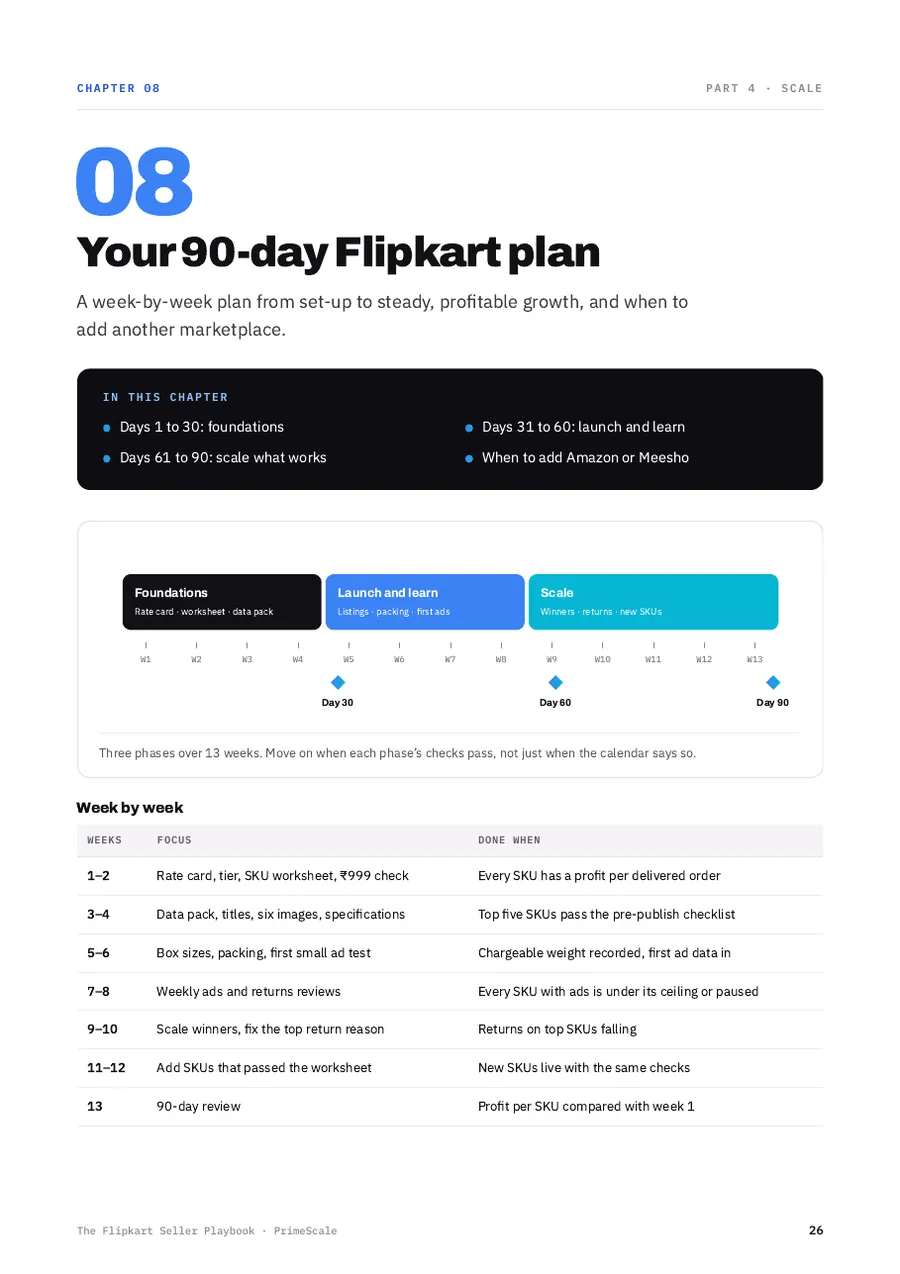
08Your 90-day Flipkart plan
A week-by-week plan from set-up to steady, profitable growth, and when to add another marketplace.
Days 1 to 30: foundations
Days 31 to 60: launch and learn
Days 61 to 90: scale what works
When to add Amazon or Meesho
Look inside
Designed to be used, not just read
Infographics built on Flipkart’s fee rules, checklists you can tick, a worksheet for every SKU and an action box at the end of each chapter.
CoverThe ₹999 lineChargeable weightYour 90-day plan
Free chapter · Chapter 02
Unit economics and the ₹999 line
Know your real profit per delivered order, returns included, before you spend a rupee on ads.
Profit on Flipkart comes down to five things: the selling price, GST, Flipkart’s four fees, your own costs and your returns. Work them out per delivered order, because returned orders still cost you packaging, a return fee and sometimes the product.
Worked example: a ₹1,049 Home & Kitchen product
A non-fashion product priced at ₹1,049 including 18% GST, sold by a Silver seller. The 10% commission and every rate-card amount here are examples, not Flipkart’s published rates, so replace them with the ones in your Seller Hub. Product cost is ₹350, packaging and other costs are ₹20 per order shipped, 10% of orders come back, 20% of those can’t be resold, and ads run at 5% of the price.
Per delivered order at ₹1,049
Line
Amount
Selling price
₹1,049.00
GST collected (18%)
−₹160.02
Commission (10%, example)
−₹104.90
Fixed fee (Silver, example base)
−₹20.00
Collection fee (example)
−₹10.00
Shipping fee (example)
−₹60.00
Product cost
−₹350.00
Packaging and other
−₹20.00
Returns (10% returned, 20% unsellable)
−₹16.66
Ads (5% of price)
−₹52.45
Profit per delivered order
₹254.97 · 24.31% margin
Example rate card: fixed fee ₹20, collection fee ₹10, shipping fee ₹60 and a ₹60 fee on each returned order, all before GST. GST on Flipkart’s fees is claimable, so it isn’t counted as a cost.
The ₹999 line
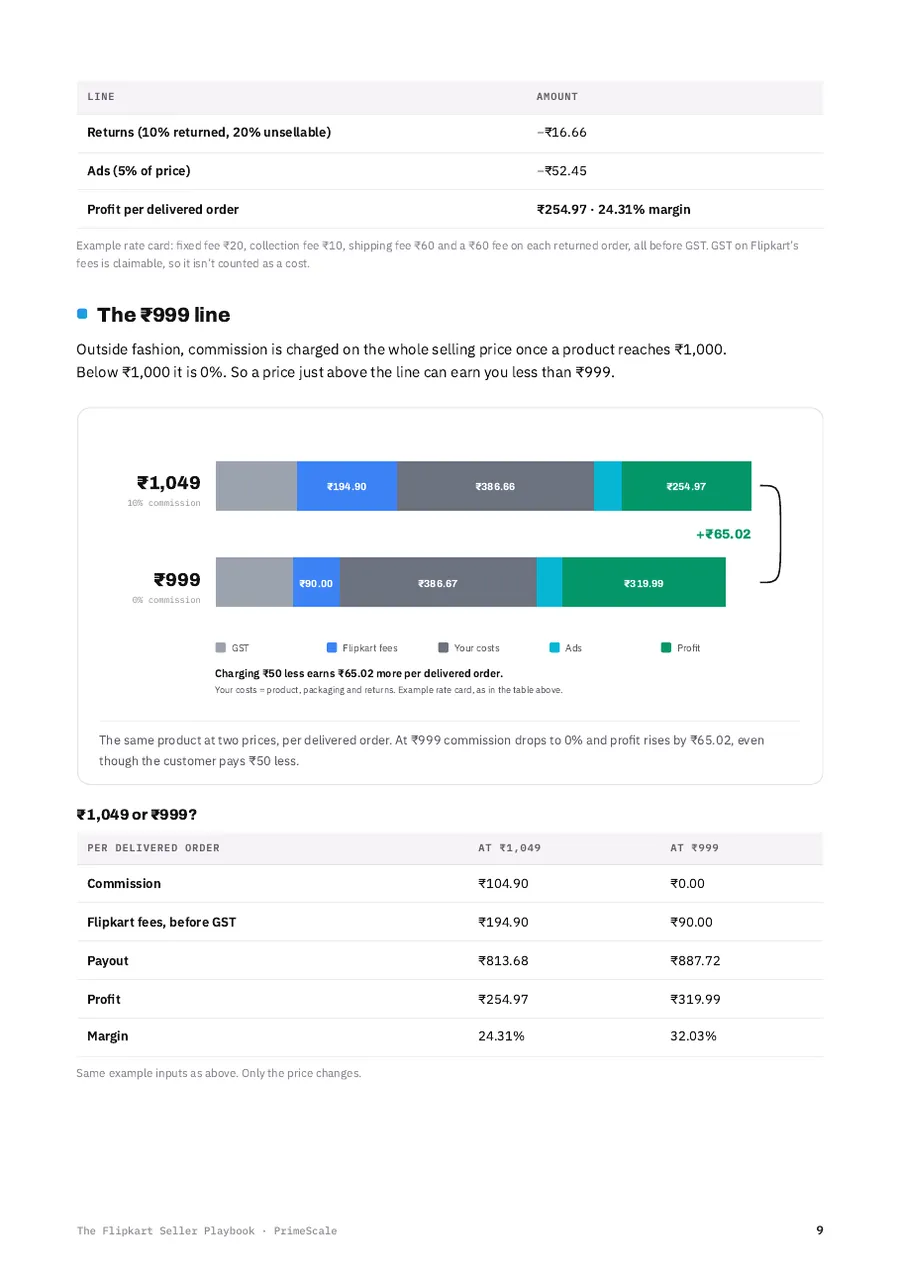
Outside fashion, commission is charged on the whole selling price once a product reaches ₹1,000. Below ₹1,000 it is 0%. So a price just above the line can earn you less than ₹999.
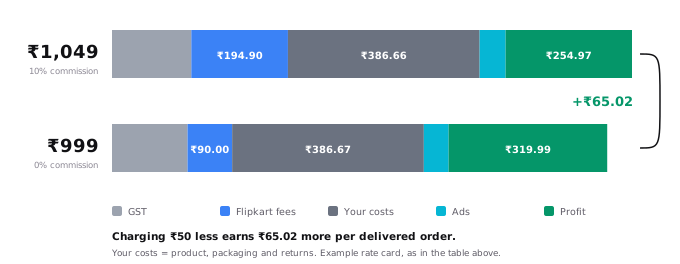
The same product at two prices, per delivered order. At ₹999 commission drops to 0% and profit rises by ₹65.02, even though the customer pays ₹50 less.
₹1,049 or ₹999?
Per delivered order
At ₹1,049
At ₹999
Commission
₹104.90
₹0.00
Flipkart fees, before GST
₹194.90
₹90.00
Payout
₹813.68
₹887.72
Profit
₹254.97
₹319.99
Margin
24.31%
32.03%
Same example inputs as above. Only the price changes.
Returns belong in unit economics
Work on 100 orders shipped. The orders that come back still cost packaging, the fee Flipkart keeps on a return and sometimes the product. Spread those costs over the orders that are delivered and you get your real profit per order.
The ₹1,049 example on 100 orders shipped
Line
Orders
Amount
Sales after GST
90 delivered
₹80,008.47
Flipkart fees
90
−₹17,541.00
Fees on returned orders
10 returned
−₹600.00
Product cost of delivered units
90
−₹31,500.00
Stock lost on returns (20% unsellable)
2
−₹700.00
Packaging and other
100
−₹2,000.00
Ads
90
−₹4,720.50
Profit on 100 orders shipped
₹22,946.97
The calculator assumes Flipkart reverses its other fees on a returned order and keeps only the return fee.
₹254.97
Profit per delivered order at ₹1,049
₹598
Lowest price that breaks even, with the same costs
29.31%
Most you can spend on ads before a delivered order makes a loss
Break-even ad spend
(Profit per delivered order + ad spend per order) ÷ selling price
Example: (₹254.97 + ₹52.45) ÷ ₹1,049 = 29.31%
Your Flipkart SKU worksheet
□ SKU, category, fashion or not
□ Selling price including GST
□ Product GST rate
□ Commission rate at this price
□ Fixed fee after tier adjustment
□ Collection fee
□ Shipping fee and chargeable weight
□ Return rate and fee on a return
□ Landed product cost
□ Packaging and other per order shipped
□ Ad spend at your target
□ Profit per delivered order
Get the full playbook
All eight chapters, free on WhatsApp
Tell us a little about your brand and we’ll send the complete PDF. Our average first reply on WhatsApp is about 6 minutes.
The complete 31-page PDF
Fee rules checked against Flipkart’s official page
An optional free audit of your pricing and listings
Questions
Is the Flipkart Seller Playbook really free?
Yes. Request it on WhatsApp and PrimeScale sends you the full PDF. There’s no payment and no obligation to work with us.
Who is the playbook for?
D2C founders preparing to launch on Flipkart, brands already selling there whose profit isn’t keeping up with sales, and Amazon sellers adding Flipkart as a second marketplace.
How current are the fee rules in the playbook?
Every fee rule was checked against Flipkart’s official fees page on 14 September 2026, including 0% commission below ₹1,000 and 0% commission on fashion at any price since 8 July 2026. Flipkart shows exact fixed, collection and shipping amounts only in Seller Hub, so worked examples use clearly labelled example amounts.
What’s inside?
Eight chapters across four parts: how Flipkart charges, unit economics and the ₹999 line, account and catalogue set-up, listings, pricing and shipping weight, ads, returns and a 13-week plan. It includes worked examples, infographics, checklists and a SKU worksheet.
Can PrimeScale run the playbook for my brand?
Yes. Partnerships start with a focused 90-day sprint. Plans start at ₹35,000 a month for brands selling up to ₹5 lakh a month.